
Article Overview
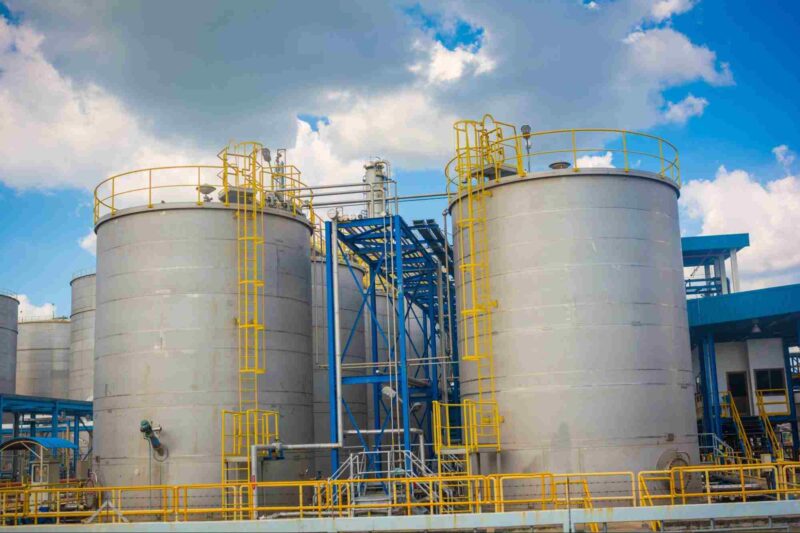
Tank vent emissions can change quickly when sour oil, produced water, or other H₂S-containing fluids enter storage. Pressure changes, agitation, temperature, and fluid movement can cause dissolved H₂S to enter the vapor space along with hydrocarbon vapors. Understanding when these releases occur helps operators identify appropriate monitoring, treatment, and emissions-control equipment for sour storage tanks.
Why Do Sour Storage Tanks Release H₂S and Hydrocarbon Vapors?
Hydrogen sulfide may remain dissolved in crude oil, produced water, condensate, and other sour fluids as they move through a closed process. Once the fluid enters storage, changes in pressure, temperature, and agitation can cause dissolved H₂S to move into the gas phase.
Tank filling can increase this release. Incoming fluid displaces vapor from the available headspace while agitation may cause additional H₂S and lighter hydrocarbons to come out of solution. Similar changes can occur during circulation, transfer, and other fluid handling activities.
This means upstream liquid measurements may not represent conditions at the tank vent. A fluid stream may show manageable H₂S levels while moving through a pressurized line, then release more H₂S after entering atmospheric storage.
For more information on how hydrogen sulfide behaves in crude oil, read our article H₂S Removal From Oil: Methods, Process, and Why It Matters. Understanding how H₂S responds to pressure, temperature, and handling conditions helps operators identify where liquid treatment and vapor control may be required.
What Causes Tank Vent Emissions to Change?
Tank vent emissions are rarely constant throughout an operating cycle. Gas flow and H₂S concentration can change as fluid enters, remains in, or leaves the tank.
Important operating factors include:
- H₂S concentration in the incoming fluid
- Tank filling rate and fluid agitation
- Pressure changes as fluids enter storage
- Fluid and ambient temperature
- Hydrocarbon content and fluid composition
- Tank level and available vapor space
- Vent gas flow and whether releases are continuous or intermittent
These conditions should be evaluated together because treatment equipment must reflect the actual vent gas flow, H₂S loading, and operating conditions. A single sample taken upstream may not show how much H₂S will enter the vapor phase after the fluid reaches storage.
Tank Gauging Supports Safer Sour Storage
Reliable tank level information helps operators manage filling and transfer activities while reducing unnecessary interaction with sour storage tanks. In H₂S service, unnecessary opening or manual access can increase the potential for worker exposure.
AMGAS’ Process Tank Gauging Systems support level measurement in sour storage applications where operators need dependable tank information without unnecessarily disturbing containment. Reliable gauging can help crews understand changing tank conditions and coordinate fluid handling more safely.
Tank level should still be considered together with H₂S concentration, vent routing, fluid properties, and other site-specific treatment requirements.
How Can H₂S Scrubbers Control Tank Vent Emissions?
When H₂S is present in the gas phase and released through a defined vent point, the vent stream can be routed through tank venting equipment before discharge. This provides a controlled approach for managing H₂S released from sour storage tanks rather than allowing untreated gas to vent directly from the tank.
H₂S Scrubbers provide a contained treatment point where sour gas contacts reactive chemistry or media to reduce hydrogen sulfide before leaving the system. This makes scrubbers suitable for tank vent applications where gas flow, H₂S concentration, and outlet performance can be monitored.
For example, a production site may receive sour crude into a storage tank throughout the day. Under normal conditions, the vent load may remain relatively stable. If production increases or incoming fluid contains a higher H₂S concentration, more hydrogen sulfide may enter the vapor space as the tank fills.
In that situation, operators need to account for the higher gas flow and H₂S loading, confirm that the treatment equipment remains within its expected operating range, and verify performance at the outlet. The treatment setup should respond to actual tank conditions rather than remain based on an earlier operating point.
Hydrocarbon vapors should also be considered when evaluating the full vent stream because vent gas composition can affect treatment planning and equipment selection.
Liquid and Vapor Treatment May Be Required Together
Controlling gas-phase H₂S at the vent does not necessarily address all hydrogen sulfide entering the tank. When H₂S remains dissolved in crude oil, produced water, condensate, or another liquid stream, operators may also need to evaluate liquid-phase treatment.
Chemical scavengers may be used where sufficient mixing, contact time, and reaction conditions are available. Reducing H₂S in the liquid can decrease the amount available to enter the vapor phase later, although gas-phase controls may still be required as pressure and operating conditions change.
For a broader comparison of chemical treatment, scrubbing, and system-based approaches, read Hydrogen Sulfide Treatment Methods: What Works and When to Use Them to understand how treatment selection changes according to H₂S phase, concentration, flow conditions, and site-specific operating requirements.
What Should Operators Understand About Tank Vent Emissions?
Effective tank vent emissions control requires operators to understand how H₂S moves between the liquid and gas phases during storage and handling. Tank filling, pressure changes, agitation, fluid composition, temperature, and production conditions can all affect the gas reaching the vent.
A practical treatment strategy should therefore account for the incoming liquid, tank conditions, vent gas flow, H₂S loading, monitoring requirements, and the final emissions target. When these factors are considered together, operators can select treatment equipment that reflects actual operating conditions and maintain more consistent control as tank conditions change.
Use the form below to contact our team and discuss a site-specific approach to managing H₂S from sour storage tanks.